For families and classrooms

Pieces of Home: Field Guide

The whole story and every fact from the game, on one page. It works without 3D, with a screen reader, and on paper.

Play the game About this game

The story

Remi is 11. Their dad died last spring. One evening, Remi and Mom go back to Dad's workshop for the first time since then. Mom waits on the porch.

Inside, Dad's desk lamp clicks on by itself. Dad built it to do that every evening, so you never come home to a dark workshop.

On the workbench sits Milo, a little robot Dad never finished. There are glass domes with tiny worlds inside, and a notebook for Remi. Tucked in the notebook are letters Dad wrote and never sent. Each one is addressed to a machine that people left on the Moon, on Mars, or far out in space.

Remi decides to deliver the letters and to finish Milo. Friends can come along.

The machines

Dad's sketch. Not to scale.

Home

The lamp

Dad's workshop lamp

Prologue: The Workshop

I made it turn on by itself. Thanks for waiting up.

Dad's note

What it was for

So you never come home to a dark workshop.

Dad's sketch. Not to scale.

Moon1969

The little mirrors

Apollo 11 Laser Ranging Retroreflector

Chapter 1: Tranquility Base

Send a light, get a light back. Works on the Moon. Works on your bedroom window too.

Dad's note

Where it is: Apollo 11 landed at Tranquility Base, close to the middle of the Moon's near side. 1

What it was for

Bouncing laser light straight back to Earth.

What we learned

  • Neil Armstrong and Buzz Aldrin set up the mirror panel near the end of their moonwalk. 2
  • The panel holds 100 little corner cubes. 3
  • A laser flash takes about 2.5 seconds to reach the mirrors and come back. 4
  • The Moon is about 385,000 km away on average. 5
  • The Moon moves about 3.8 cm farther from Earth every year. 6

Then and now

  • Scientists still bounce lasers off it today. 7
  • It needs no power at all. 8

Deeper notes

  • Apollo 14 and Apollo 15 left mirror panels too. 9
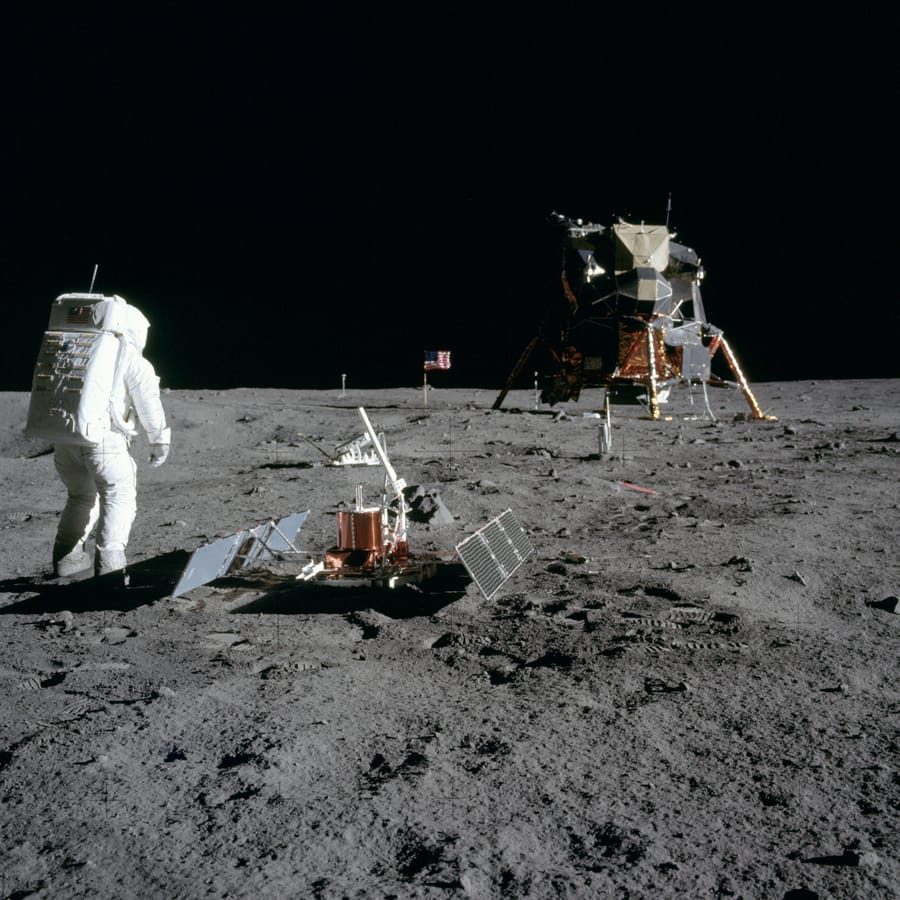
Buzz Aldrin stands on the Moon next to a quake sensor, with the laser mirror panel just behind it and the lunar lander far away.
Astronaut Edwin Aldrin after deployment of EASEP on surface of moon (AS11-40-5948), July 20, 1969. Photo: NASA. Source
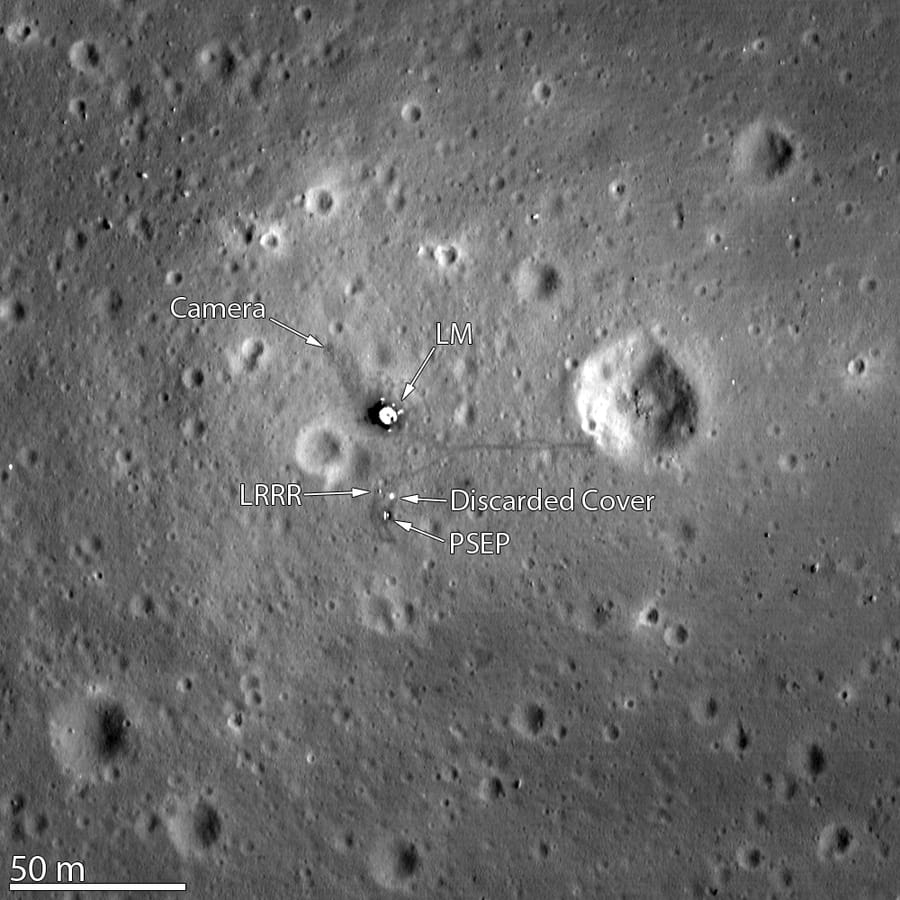
A view from space of Tranquility Base, with labels for the lander, the laser mirror panel and the dark paths the astronauts walked.
A Stark Beauty All Its Own (LROC M175124932R), November 5, 2011. Photo: NASA/GSFC/Arizona State University. Source
Dad's sketch. Not to scale.

Moon

The Moon buggy

Apollo 15 Lunar Roving Vehicle

Chapter 2: Hadley-Apennine

You don't always steer from the front. Sometimes someone steadies you from behind.

Dad's note

Where it is: Apollo 15 landed at Hadley-Apennine, beside a long winding valley called Hadley Rille. 10

What it was for

Letting astronauts drive farther than they could walk.
What we learned

  • Its wheels were woven from zinc-coated steel wire, with titanium chevrons for grip. 11
  • On Apollo 15 the rover drove 27.8 km in about 3 hours of driving. 12
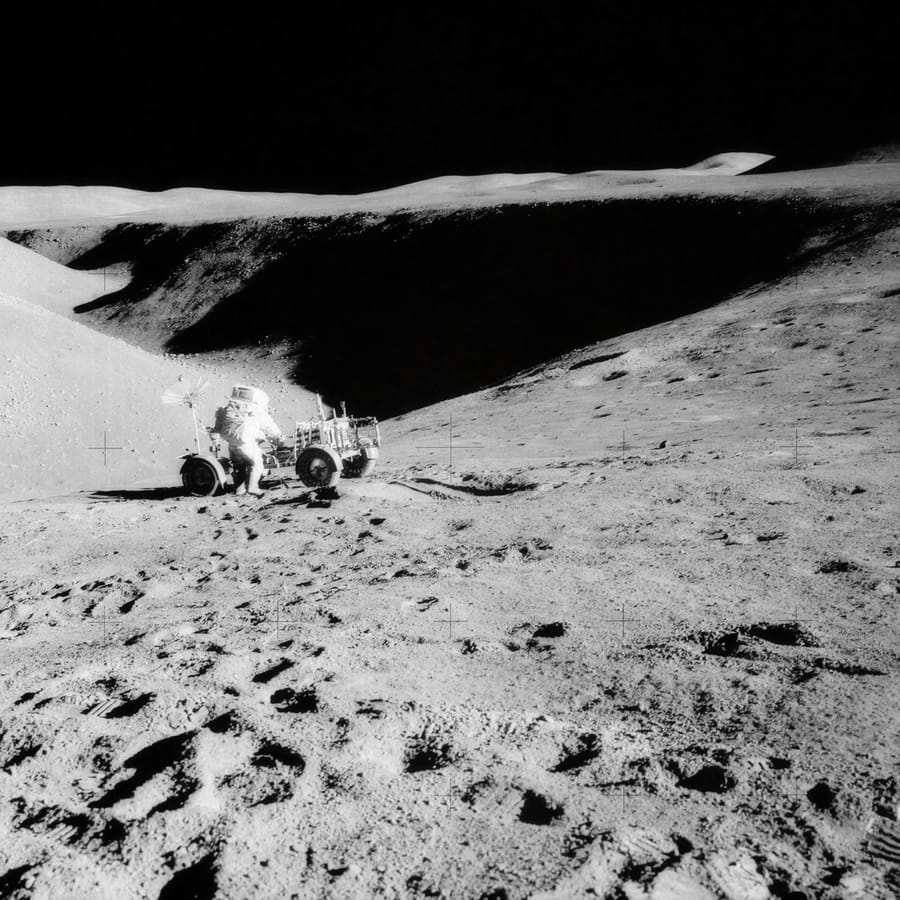
An astronaut works at the Moon rover, parked at the edge of a deep, winding valley called Hadley Rille.
Astronaut David Scott on slope of Hadley Delta during Apollo 15 EVA (AS15-85-11451), July 31, 1971. Photo: NASA. Source
Dad's sketch. Not to scale.

Mars

The rover that kept going

Opportunity, Mars Exploration Rover

Chapter 3: Meridiani Planum

Some days are dusty. Wait for the wind.

Dad's note

Where it is: Opportunity came to rest in a small crater on the plains of Meridiani Planum, near the Mars equator. 13

What it was for

A robot geologist, looking for signs of old water.

What we learned

  • It was planned to work for 90 Martian days. 14
  • It kept working for more than 14 years. 15
  • It drove 45.16 km, farther than a marathon. 16
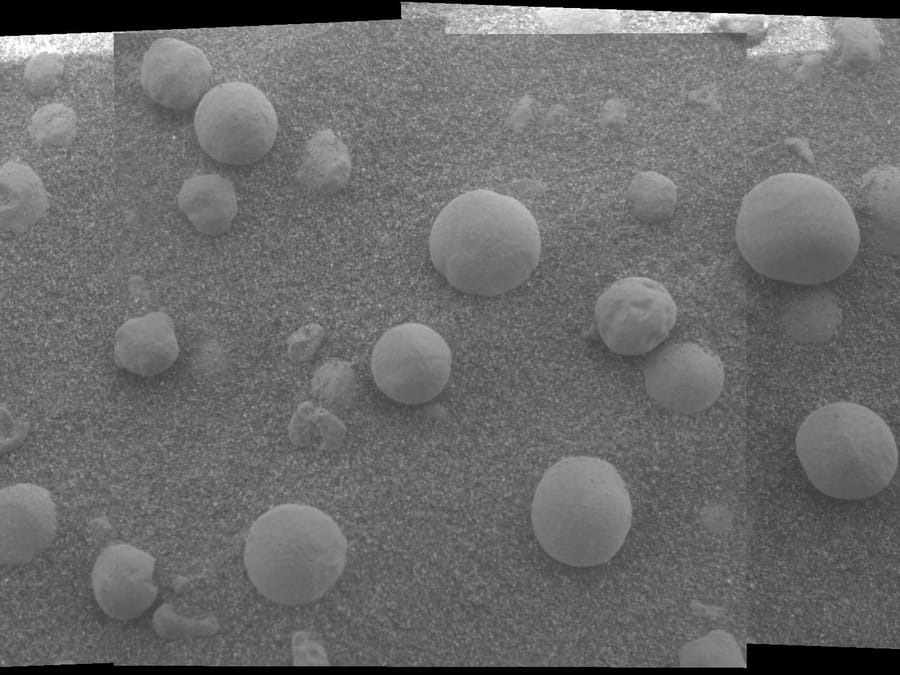
  • It found tiny hematite balls nicknamed "blueberries" that formed with water. 17
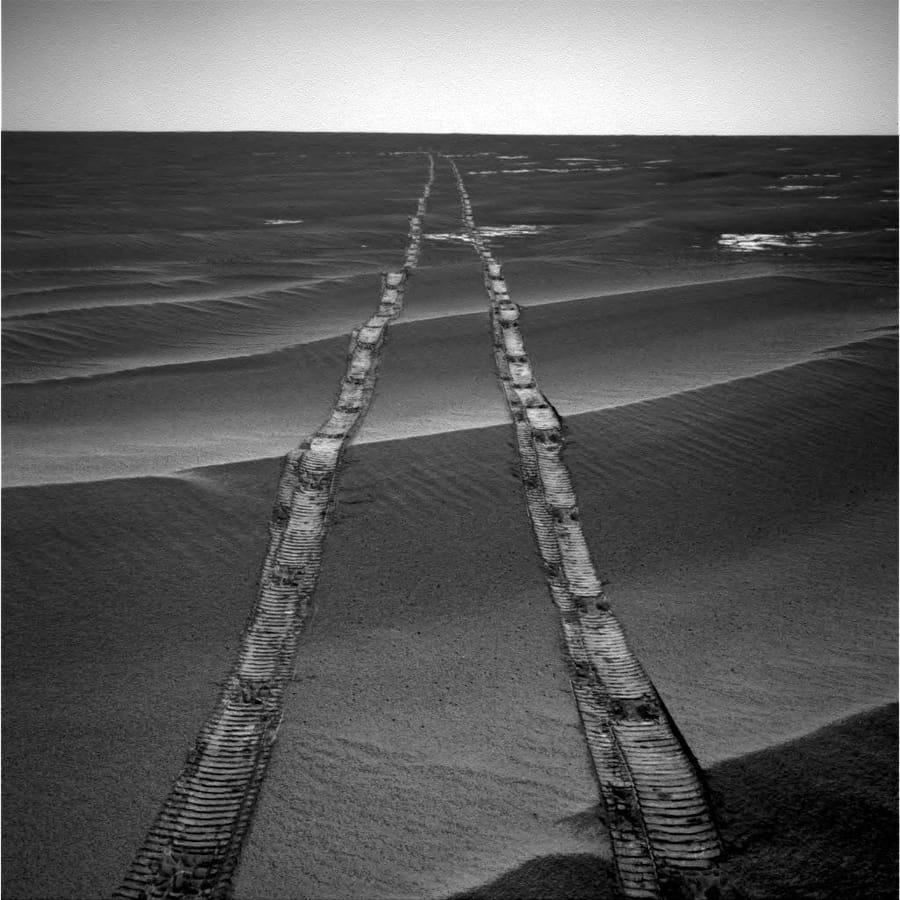
Opportunity looks back at its own two wheel tracks, stretching across wavy Martian sand to the far edge of the land.
Looking Back on a Golden Opportunity (PIA22928), August 4, 2010. Photo: NASA/JPL-Caltech. Source
A very close look at small round pebbles called blueberries, sitting in the Martian soil.
"Berries" on the Ground (PIA05273), February 12, 2004. Photo: NASA/JPL/Cornell/USGS. Source
Dad's sketch. Not to scale.

Mars2021

The little helicopter

Ingenuity Mars Helicopter

Chapter 4: Valinor Hills

Every good flying machine carries a little piece of where it came from.

Dad's note

What it was for

Finding out if flying on another planet could work.

What we learned

  • Ingenuity made the first powered, controlled flight on another planet. 18
  • It flew 72 times, more than 2 hours in all, 14 times farther than planned. 19
  • It carries a tiny piece of the 1903 Wright Flyer's wing fabric. 20

Then and now

  • Its last flight damaged its rotor blades. 21
  • It stays at "Valinor Hills" and keeps saving data for future visitors. Its memory could hold about 20 years of daily data. 22
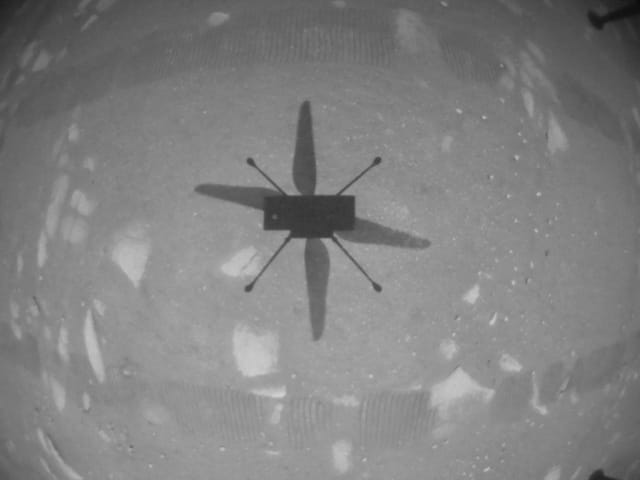
Ingenuity took this picture of its own shadow on the ground while it hovered over Mars on its first flight.
Ingenuity's First Black-and-White Image From the Air (PIA24584), April 19, 2021. Photo: NASA/JPL-Caltech. Source
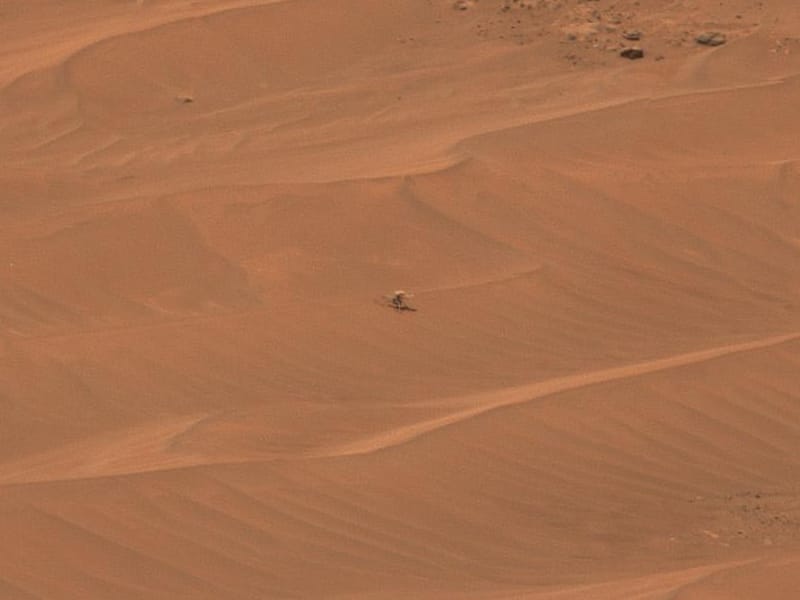
Ingenuity stands alone as a tiny speck among wavy sand ripples on Mars, at the spot where it made its last flight.
Ingenuity at 'Valinor Hills' (PIA26237, detail), February 21, 2024. Photo: NASA/JPL-Caltech/ASU/MSSS. Source
Dad's sketch. Not to scale.

Space2026

The farthest letter

Voyager 1

Finale: The Long Light

I couldn't know every question you would ask. I just wanted to leave you a little company while you found the answers.

Dad's note

What it was for

Carrying a message from Earth, farther away than any other machine.
What we learned

  • On November 18, 2026, Voyager 1 becomes the first human-made object one light-day from Earth: its signals will take a whole day to reach us. 23
  • Each Voyager carries a Golden Record with greetings in 55 languages, pictures, music and sounds of Earth. 24

Deeper notes

  • Voyager 2 won't reach one light-day until around 2035. 25
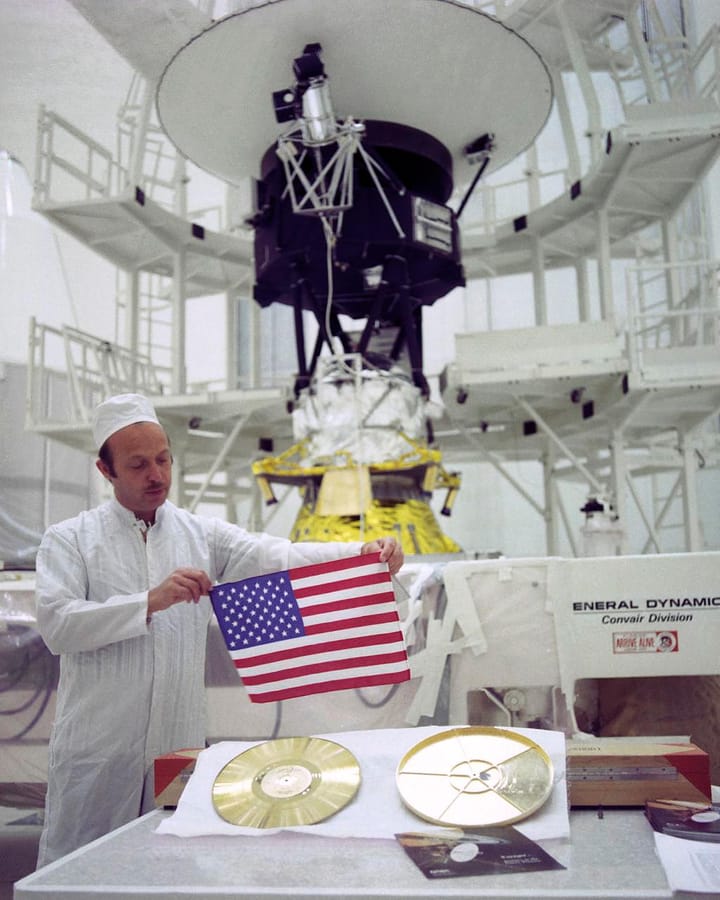
A worker holds a small flag in front of the Voyager 2 spacecraft, with the shiny Golden Record and its cover on the table below.
Mementos of Earth (PIA17035), August 4, 1977. Photo: NASA/JPL-Caltech. Source

Using this in class

  1. Read one machine at a time. Each one fits on a page or two.
  2. Ask: what was it built to do, and what is it still doing?
  3. Every number has a source link. Older kids can open the source and check it.

Sources

Every fact in the game, with where it comes from and the day we last checked it.
  1. Apollo 11 landed at Tranquility Base, close to the middle of the Moon's near side. NSSDCA: Apollo Landing Site Coordinates (checked November 10, 2026)
  2. Neil Armstrong and Buzz Aldrin set up the mirror panel near the end of their moonwalk. NASA Science: Apollo 11 Experiment Still Running (2004), archived copy
  3. The panel holds 100 little corner cubes. JPL: Earth-Moon System
  4. A laser flash takes about 2.5 seconds to reach the mirrors and come back. JPL: The Apollo Experiment That Keeps on Giving (2019)
  5. The Moon is about 385,000 km away on average. JPL: The Apollo Experiment That Keeps on Giving (2019)
  6. The Moon moves about 3.8 cm farther from Earth every year. JPL: The Apollo Experiment That Keeps on Giving (2019)
  7. Scientists still bounce lasers off it today. JPL: The Apollo Experiment That Keeps on Giving (2019)
  8. It needs no power at all. JPL: Earth-Moon System
  9. Apollo 14 and Apollo 15 left mirror panels too. JPL: The Apollo Experiment That Keeps on Giving (2019)
  10. Apollo 15 landed at Hadley-Apennine, beside a long winding valley called Hadley Rille. NSSDCA: Apollo Landing Site Coordinates (checked November 10, 2026)
  11. Its wheels were woven from zinc-coated steel wire, with titanium chevrons for grip. NSSDCA: The Apollo Lunar Roving Vehicle
  12. On Apollo 15 the rover drove 27.8 km in about 3 hours of driving. NSSDCA: The Apollo Lunar Roving Vehicle
  13. Opportunity came to rest in a small crater on the plains of Meridiani Planum, near the Mars equator. NSSDCA: Opportunity spacecraft details (checked November 10, 2026)
  14. It was planned to work for 90 Martian days. NASA/JPL: Six things to know about NASA's Opportunity Mars rover (2019), reprint on Phys.org
  15. It kept working for more than 14 years. NASA/JPL: Six things to know about NASA's Opportunity Mars rover (2019), reprint on Phys.org
  16. It drove 45.16 km, farther than a marathon. NASA/JPL: Six things to know about NASA's Opportunity Mars rover (2019), reprint on Phys.org
  17. It found tiny hematite balls nicknamed "blueberries" that formed with water. NASA/JPL: Six things to know about NASA's Opportunity Mars rover (2019), reprint on Phys.org
  18. Ingenuity made the first powered, controlled flight on another planet. NASA APPEL: NASA's Ingenuity Rotorcraft Makes Final Landing on Mars (2024)
  19. It flew 72 times, more than 2 hours in all, 14 times farther than planned. JPL: NASA's Ingenuity Mars Helicopter Team Says Goodbye ... for Now (April 16, 2024)
  20. It carries a tiny piece of the 1903 Wright Flyer's wing fabric. JPL PIA24434: The Wright Brothers
  21. Its last flight damaged its rotor blades. JPL: NASA's Ingenuity Mars Helicopter Team Says Goodbye ... for Now (April 16, 2024)
  22. It stays at "Valinor Hills" and keeps saving data for future visitors. Its memory could hold about 20 years of daily data. JPL: NASA's Ingenuity Mars Helicopter Team Says Goodbye ... for Now (April 16, 2024)
  23. Voyager 1 becomes the first human-made object one light-day from Earth: its signals take a whole day to reach us. EarthSky: Voyager 1 will be 1 light-day from Earth (citing NASA's June 17, 2026 statement)
  24. Each Voyager carries a Golden Record with greetings in 55 languages, pictures, music and sounds of Earth. The Planetary Society: The Voyager Golden Record
  25. Voyager 2 won't reach one light-day until around 2035. EarthSky: Voyager 1 will be 1 light-day from Earth (citing NASA's June 17, 2026 statement)

Pictures, fonts and code

Pictures

  • CGI Moon Kit color map (lroc_color_poles_1k). NASA's Scientific Visualization Studio. Public domain (NASA SVS: all content is in the public domain unless otherwise noted). Source
  • Mars Viking Colorized Global Mosaic (MDIM 2.1). NASA Ames / USGS Astrogeology Science Center. Public domain (USGS page: Access Constraints Public domain, Use Constraints None). Source
  • Astronaut Edwin Aldrin after deployment of EASEP on surface of moon (AS11-40-5948). NASA. Public domain (NASA media). Source
  • A Stark Beauty All Its Own (LROC M175124932R). NASA/GSFC/Arizona State University. Public domain (NASA media). Source
  • Astronaut David Scott on slope of Hadley Delta during Apollo 15 EVA (AS15-85-11451). NASA. Public domain (NASA media). Source
  • Looking Back on a Golden Opportunity (PIA22928). NASA/JPL-Caltech. Public domain (NASA media). Source
  • "Berries" on the Ground (PIA05273). NASA/JPL/Cornell/USGS. Public domain (NASA media). Source
  • Ingenuity's First Black-and-White Image From the Air (PIA24584). NASA/JPL-Caltech. Public domain (NASA media). Source
  • Ingenuity at 'Valinor Hills' (PIA26237, detail). NASA/JPL-Caltech/ASU/MSSS. Public domain (NASA media). Source
  • Mementos of Earth (PIA17035). NASA/JPL-Caltech. Public domain (NASA media). Source

Fonts

  • Kalam by Indian Type Foundry, SIL Open Font License 1.1. Source
  • Fraunces by Undercase Type (Phaedra Charles, Flavia Zimbardi), SIL Open Font License 1.1. Source
  • Atkinson Hyperlegible Next by Braille Institute of America, SIL Open Font License 1.1. Source
  • Zilla Slab by Mozilla, Typotheque, SIL Open Font License 1.1. Source
  • OpenDyslexic by Abbie Gonzalez, SIL Open Font License 1.1. Source

Code